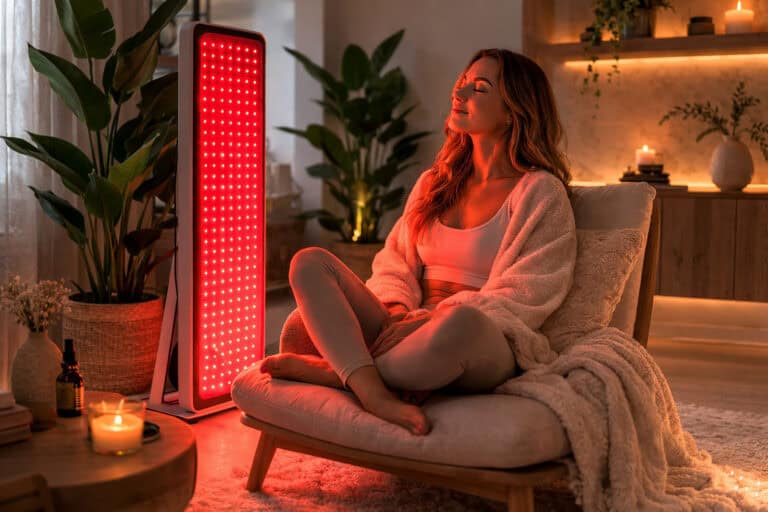
Red Light Therapy Research: What the Evidence Shows

Red light therapy research has grown quickly over the last decade, but the evidence is not equally strong for every use. Some areas, especially skin-focused applications and certain pain-related outcomes, look more encouraging than broad marketing claims suggest. Other areas remain early, mixed, or highly dependent on treatment parameters such as wavelength, dose, distance, timing, and treatment consistency.
This matters because red light therapy is often discussed as if it were one single intervention with one universal result. In reality, photobiomodulation studies vary widely in device design, treatment schedule, target tissue, and outcome measures. That means the best way to understand the science is not to ask whether red light therapy “works” in a general sense, but to ask for what purpose, under what conditions, and with how much certainty.
On this page, we’ll look at what the current evidence base actually supports, where it is still limited, and how to interpret results without overpromising. For a broader overview of the category, see our red light therapy buyer’s guide. You can also review our science-focused red light therapy benefits page for a more general summary of commonly discussed outcomes.
Want the practical side too?
After reviewing the evidence, compare educational takeaways with our guide to the top red light therapy devices →
What researchers mean by red light therapy
In research settings, red light therapy is usually grouped under the broader term photobiomodulation (PBM). That umbrella can include red wavelengths, near-infrared wavelengths, LEDs, and low-level laser devices. In other words, many studies that people cite as “red light therapy research” may actually involve a broader PBM protocol rather than a simple at-home red LED panel.
That distinction is important because it explains why results can be hard to compare from study to study. One trial may use a tightly controlled medical-grade laser on a small treatment area. Another may use an LED array with different power density, treatment duration, or pulse settings. Even when both are labeled PBM, they are not automatically interchangeable.
Researchers generally describe PBM as a non-thermal light-based intervention that may influence cellular signaling, tissue repair, inflammation pathways, and subjective symptoms such as pain. Cleveland Clinic also describes red light therapy as an emerging treatment with some promising results, while emphasizing that more clinical trials are still needed before many popular claims can be considered well established. [oai_citation:0‡Cleveland Clinic](https://my.clevelandclinic.org/health/articles/22114-red-light-therapy)
For a more detailed explanation of mechanism language, visit how red light therapy works at the cellular level.
Why the mechanisms look plausible in the lab
The scientific interest in PBM exists for a reason: there is a plausible biological basis for why light in the red and near-infrared range may affect cellular behavior. Mechanistic reviews commonly focus on light absorption by cellular chromophores, especially mitochondrial cytochrome c oxidase, with downstream effects that may include changes in ATP production, reactive oxygen species signaling, calcium signaling, and nitric oxide availability. [oai_citation:1‡PubMed](https://pubmed.ncbi.nlm.nih.gov/28070154/?utm_source=chatgpt.com)

That mechanistic plausibility is one reason PBM continues to attract research interest across skin health, musculoskeletal recovery, circulation-related questions, and general tissue repair. But a plausible mechanism is not the same thing as a proven clinical outcome. Laboratory findings help justify further study, yet real-world effectiveness depends on whether those biological effects reliably translate into meaningful improvements for actual people under standardized conditions.
This is also why wavelength and dosing matter so much. A biologically active light dose is not simply “more is better.” Reviews of PBM mechanisms repeatedly note dose sensitivity and parameter dependence, which helps explain why inconsistent protocols often produce inconsistent clinical results. [oai_citation:2‡PubMed](https://pubmed.ncbi.nlm.nih.gov/28070154/?utm_source=chatgpt.com)
Where the evidence looks strongest so far
If you zoom out across the literature, two of the more encouraging evidence areas are certain dermatology outcomes and some pain-related applications. That does not mean every skincare or pain claim is proven. It means these are the categories where the evidence base tends to look more developed than broad wellness claims.
For skin-related uses, a 2023 systematic review and meta-analysis on LED skin therapy found statistically significant benefits in areas such as acne and some skin rejuvenation outcomes, while also noting that other applications showed higher heterogeneity. [oai_citation:3‡PubMed](https://pubmed.ncbi.nlm.nih.gov/36310510/)
For pain-related applications, the 2025 umbrella review of randomized clinical trials concluded that PBM is increasingly used for pain, inflammation, and tissue repair, and synthesized evidence across many existing meta-analyses rather than relying on a single narrow indication. [oai_citation:4‡PMC](https://pmc.ncbi.nlm.nih.gov/articles/PMC12326686/)

In practical terms, this means the research conversation is no longer only theoretical. There are now multiple systematic reviews and meta-analyses showing that PBM deserves serious attention in selected use cases. The key limitation is that “selected use cases” is much narrower than “everything people market it for.”
Skin research: encouraging, but not unlimited
Skin is one of the easier targets to study because light can directly reach superficial tissue, and common outcomes such as wrinkles, acne, erythema, texture, and healing can be measured with clinical tools and photography. That helps explain why dermatology remains one of the more active PBM research categories.
Cleveland Clinic notes that red light therapy is showing promise for wrinkles, redness, acne, scars, and other signs of aging, but also states that more clinical trials are needed and that the full effectiveness has not yet been determined. [oai_citation:5‡Cleveland Clinic](https://my.clevelandclinic.org/health/articles/22114-red-light-therapy)
The skin-therapy meta-analysis published in 2023 also found encouraging signal strength for acne and skin rejuvenation-related outcomes, while making clear that some indications showed inconsistent data quality or study heterogeneity. [oai_citation:6‡PubMed](https://pubmed.ncbi.nlm.nih.gov/36310510/)
That is the pattern readers should keep in mind: skin applications are among the more evidence-supported areas, but the evidence is still not a blank check for every aesthetic claim, every device, or every protocol. A study showing benefit with one wavelength and treatment schedule does not automatically validate all consumer devices marketed for “anti-aging.”
Pain and recovery research: promising, but protocol-sensitive
Musculoskeletal pain and recovery are often discussed in red light therapy marketing, and the literature here does include meaningful signals. At the same time, results depend heavily on condition, comparator treatment, and whether PBM is used alone or as an adjunct.
For example, a 2023 systematic review and meta-analysis on plantar fasciitis found that PBMT improved pain intensity with or without exercise and was superior to extracorporeal shock wave therapy for pain relief in the included data, while also stating that uncertainty remains for disability-related outcomes and that adjunct use with other electrotherapeutic modalities was not supported. [oai_citation:7‡PubMed](https://pubmed.ncbi.nlm.nih.gov/37464155/)

This is a useful example of how to read PBM research responsibly. It is fair to say that some pain-related applications look promising. It is not fair to flatten that into a claim that red light therapy is definitively proven for all injuries, all recovery scenarios, or all chronic pain conditions.
If recovery is your main interest, you may also want to read our guide to red light therapy for muscle recovery.
Why the evidence can look confusing to readers
One reason red light therapy research can feel contradictory is that studies often use very different:
- wavelengths and bandwidths
- power densities and total dose
- treatment distances
- session durations and weekly frequency
- device types, including lasers versus LEDs
- target tissues and outcome measures
That means two studies can both appear to investigate “red light therapy,” while actually testing quite different interventions. The 2025 umbrella review highlights this broader challenge by synthesizing meta-analyses across many health outcomes rather than implying a single universal effect size. [oai_citation:8‡PMC](https://pmc.ncbi.nlm.nih.gov/articles/PMC12326686/)
For consumers, the takeaway is simple: broad claims should be treated cautiously. Stronger evidence usually attaches to a specific protocol for a specific outcome, not to a general category claim like “red light therapy boosts everything.”

What the research does not yet prove
It is just as important to understand what the evidence does not yet prove. Current research does not justify framing red light therapy as a cure-all, a replacement for medical diagnosis, or a guaranteed fix for systemic health concerns. Many consumer-facing claims move much faster than the highest-quality evidence.
Cleveland Clinic’s summary is useful here because it acknowledges the promise while directly stating that there is not enough evidence to support most uses at this point. [oai_citation:9‡Cleveland Clinic](https://my.clevelandclinic.org/health/articles/22114-red-light-therapy)
That does not mean the therapy lacks value. It means the honest evidence-based position is narrower: PBM may support some outcomes, especially in selected skin and pain contexts, but the strength of support varies significantly by indication. This is exactly why conservative language matters in a wellness or educational setting.
Looking for a balanced next step?
Review the science, then compare how different at-home formats are positioned in our Red Light Sage blog index →
What the evidence suggests about safety
When used appropriately, PBM is generally discussed as a non-invasive and relatively well-tolerated modality. But “generally well-tolerated” is not the same as “risk-free in every context.” Device intensity, eye exposure, heat buildup, skin sensitivity, and individual medical context still matter.
A 2023 systematic review focused on oncologic safety in aesthetic skin rejuvenation found no relevant clinical trial data linking PBM with significant adverse events such as new or recurrent malignancy in that context, and concluded that current clinical and preclinical evidence suggests oncologic safety for skin rejuvenation within established parameters. [oai_citation:10‡PubMed](https://pubmed.ncbi.nlm.nih.gov/36722207/)
That is reassuring, but it should still be interpreted precisely. It supports the idea that PBM safety concerns are often overstated in aesthetic-skin contexts under studied conditions. It does not mean every device, every dosing pattern, or every self-directed use case has been equally well studied.
For a more practical overview, visit how to use red light therapy safely or contact Red Light Sage if you want help finding the right educational starting point.
How to read a red light therapy study without being misled
When you evaluate red light therapy research, ask a few simple questions:
- What exact outcome was measured? Pain score, wrinkle depth, lesion count, healing speed, sleep quality, or something else?
- What device and protocol were used? Wavelength, dose, treatment time, and frequency are essential.
- Was there a control or sham condition? This matters for confidence in the result.
- Was the study small? Small studies can be encouraging, but they are not final proof.
- Was the result clinically meaningful? A statistically significant change is not always a big real-world change.
This kind of reading discipline is especially useful in PBM because the research base is broad but uneven. Strong marketing often jumps from mechanistic plausibility to clinical certainty without pausing at the messy middle where actual evidence lives.
If you want to understand parameter basics first, read red light therapy wavelengths explained.
The current bottom line on red light therapy research
The best evidence-based summary today is this: red light therapy research is credible enough to take seriously, but not broad enough to justify sweeping claims.
Mechanism research gives PBM a plausible scientific foundation. Systematic reviews and meta-analyses support continued interest, especially for skin-related uses and some pain-focused applications. At the same time, study quality, heterogeneity, and protocol variation still limit how confidently results can be generalized. [oai_citation:11‡PMC](https://pmc.ncbi.nlm.nih.gov/articles/PMC12326686/)

That makes PBM a category where nuance is a strength, not a weakness. The most trustworthy takeaway is not “it works for everything,” but “some applications appear more supported than others, and protocol quality matters.”
Frequently asked questions about red light therapy research
Does research show that red light therapy works?
Research suggests that red light therapy may support certain outcomes, especially in selected skin-related and pain-related contexts, but the evidence is not equally strong for every advertised use. Study design and treatment parameters matter a great deal. [oai_citation:12‡PMC](https://pmc.ncbi.nlm.nih.gov/articles/PMC12326686/)
What is the biggest limitation in red light therapy studies?
The biggest limitation is inconsistency. Studies often use different wavelengths, treatment schedules, doses, devices, and target outcomes, which makes it hard to generalize one result across the entire category. [oai_citation:13‡PMC](https://pmc.ncbi.nlm.nih.gov/articles/PMC12326686/)
Is the safety research reassuring?
In the contexts that have been studied, PBM is generally described as non-invasive and relatively well tolerated, and a 2023 systematic review found no evidence of significant adverse oncologic events in the skin-rejuvenation literature it examined. That said, safe use still depends on appropriate parameters and context. [oai_citation:14‡PubMed](https://pubmed.ncbi.nlm.nih.gov/36722207/)
Conclusion: evidence first, hype second
Red light therapy research is real, growing, and worth paying attention to. The strongest reading of the literature is not that PBM is a miracle tool, but that it is a serious area of study with promising signals in selected applications and important limitations everywhere else.
If you approach the topic with that mindset, you will make better decisions. Mechanistic plausibility matters. Controlled trials matter more. Systematic reviews matter even more than individual headline-grabbing studies. And careful interpretation matters most of all.
To keep exploring, compare the evidence with practical buying considerations in our best red light therapy devices guide, browse more educational content in the Red Light Sage blog, or use our contact page if you want help navigating the topic further.