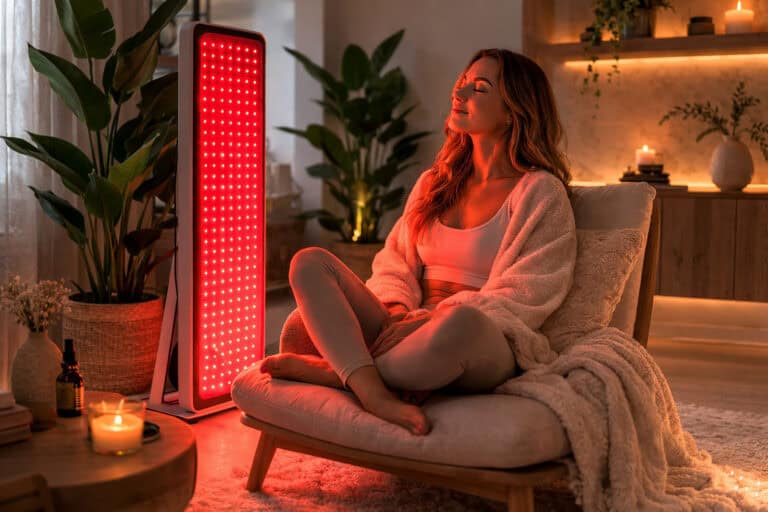
Rouge Red Light Therapy Panel Review

The Rouge Red Light Therapy Panel Review is best understood as a review of Rouge’s home-panel lineup rather than a single one-size-fits-all device. Rouge Care currently markets several G4 panels, including tabletop, mid-size, and larger full-body models, and the company emphasizes eight wavelengths, app-connected controls, and high-output multi-chip LEDs across the line. On its official site, Rouge describes the Tabletop G4, Pro G4, Max G4, and Ultimate G4 as part of the same modern panel family, with the larger models adding more LEDs, broader treatment area, and more mounting flexibility. Rouge’s official product collection, Tabletop G4, Pro G4, and Max G4 provide the clearest picture of what the brand is offering today.
That matters because Rouge sits in the premium side of the at-home red light therapy market. The brand is not really aiming at the “cheap starter panel” buyer. Instead, it appears to target people who want a cleaner user interface, more treatment flexibility, and a more polished in-home setup. If your goal is a basic entry-level panel, Rouge may feel like more device than you need. If your goal is a more permanent home wellness station, the Rouge approach may feel more aligned.
Compare Before You Buy
See how Rouge fits into the broader market in our Best Red Light Therapy Devices buyer’s guide →
Where Rouge Fits in the Home Panel Market
Rouge appears to position itself as a premium home-use brand focused on panel-based photobiomodulation. The company highlights third-party testing, multi-wavelength design, app integration, preset protocols, and larger treatment formats. That places Rouge closer to brands competing on features and whole-body usability than to small consumer gadgets meant only for occasional facial use. Rouge’s homepage and its G4 product pages repeatedly frame the line around broader wellness goals such as skin support, recovery, and at-home routine consistency.
From an editorial standpoint, that positioning makes Rouge most relevant for three types of buyers:
- People building a dedicated wellness corner at home
- Users who want panel options ranging from tabletop to full-body
- Buyers who care about controls, presets, and upgrade path more than rock-bottom price
In other words, Rouge is probably not the first panel you buy because you are merely curious. It is more likely the panel family you consider when you already believe red light therapy can fit your weekly routine and you want equipment that looks and behaves like a long-term home device.
How Rouge’s Design Aligns With Red Light Therapy Basics
Photobiomodulation is commonly described in the scientific literature as the use of red and near-infrared light to influence cellular processes, especially through mitochondrial signaling, ATP-related activity, nitric oxide pathways, and downstream tissue responses. Review literature from PubMed Central frequently discusses these mechanisms in cautious, non-cure language rather than as guaranteed outcomes. See the broader overviews on anti-inflammatory photobiomodulation mechanisms, mitochondrial redox signaling, and a 2024 review on light-based skin applications.
This matters for a product review because a panel should not be judged only by marketing language. It should be judged by whether its hardware and use case make sense for how red and near-infrared light are actually used at home. Rouge’s panel strategy broadly aligns with that practical framework: larger treatment area, multi-wavelength output, a fixed panel format, and options for users who want either targeted sessions or more full-body exposure depending on model.

That does not automatically make Rouge the best choice for everyone. It simply means the brand is at least building around the same general principles most home-panel shoppers are evaluating: wavelengths, coverage, convenience, consistency, and whether the device is easy enough to use often.
Rouge Panel Hardware and Specs: What Stands Out
The strongest part of the Rouge lineup is its hardware presentation. The current G4 line emphasizes eight wavelengths, 5W multichip LEDs, and different panel sizes for different treatment areas. On the official product pages, Rouge states that the Tabletop G4 includes 72 LEDs, the Pro G4 includes 288 LEDs, the Max G4 includes 576 LEDs, and the Ultimate G4 includes 1,152 LEDs. The brand also highlights preset protocols, smart controls, and app connectivity on the larger G4 models. These details are presented directly on Rouge’s official product pages for the Tabletop G4, Pro G4, Max G4, and Ultimate G4.
From a practical perspective, here is what that likely means for buyers:
- Tabletop: better for face, neck, desk, vanity, or smaller targeted zones
- Mid-size panel: better for rotating shoulder, back, leg, and torso use
- Larger panels: better for people who want to reduce setup friction and cover more of the body at once
That size progression is a real advantage. Some brands only offer one or two form factors. Rouge gives a more visible ladder from compact to full-body, which can make buying easier for users who already know where the panel will live in the home.
Ease of Use in a Real Home Routine
One of the easiest ways to judge a panel is to ask whether you can picture yourself using it four or five times per week without turning it into a project. Rouge scores well here. The G4 line appears designed around cleaner controls and faster repeat use, which is more important than many buyers realize. The problem with a technically impressive panel is that it still fails if it is too inconvenient to position, program, or store.

Rouge’s panel lineup looks best suited to these routine scenarios:
- Morning skincare or “wake-up” sessions with a tabletop or smaller upright panel
- Post-workout recovery sessions in a garage gym or spare room
- Dedicated evening wellness sessions with a larger stationary panel
- Households where one device may be used by more than one person
The brand’s focus on presets and app-style controls should help users who do not want to memorize settings every time. That convenience is not a minor feature. In home wellness equipment, convenience is often what separates a device that gets used consistently from one that ends up leaning against a wall.
Coverage Is One of Rouge’s Strongest Selling Points
Coverage is where Rouge becomes more compelling. Many people shopping for a red light panel underestimate how much session friction comes from moving a small device around the body. A compact panel may be enough for face care or a single joint. But once you want to cover upper back, quads, hamstrings, or more general front-body exposure, larger formats become easier to live with.
The Max G4 and Ultimate G4 are clearly built for that broader coverage approach. Rouge states that these larger panels are intended for more full-body exposure, wider coverage, and taller users, with the Ultimate positioned as the broadest and most comprehensive option in the current lineup. That makes Rouge especially interesting for buyers who already know they do not want to outgrow a starter device too quickly. Rouge Max G4 official page; Rouge Ultimate G4 official page.

If your use case is mostly:
- facial skincare,
- small-area recovery, or
- budget-conscious experimentation,
then Rouge may be more than necessary. But if your use case is “I want a serious home panel that covers more area and feels like a stable wellness appliance,” Rouge makes more sense.
What May Be Less Appealing About Rouge
No review is complete without the tradeoffs. Rouge has a polished premium feel, but that also means the main downsides are fairly predictable.
1. It may be overbuilt for beginners
If you are just testing whether red light therapy fits your life, Rouge’s higher-end panel philosophy may feel premature. A smaller or less expensive entry device can be easier to justify for trial use.
2. Premium features do not matter equally to everyone
App connectivity, presets, and advanced controls sound appealing, but some buyers simply want an on/off panel with simple red and near-infrared use. If that is you, Rouge’s sophistication may not add proportional value.
3. Large-panel ownership requires space planning
Rouge’s larger models seem best suited to a stable home location. If you live in a very small apartment, move often, or need something you can easily tuck away after every session, the larger Rouge models may feel less practical than the marketing photos suggest.

None of these issues are flaws in the strict sense. They are fit issues. Rouge looks strongest when matched to the right buyer profile.
Who Rouge Is Best For
Rouge is probably a better fit for intermediate and serious home users than for purely curious first-timers. The brand makes the most sense if you want your panel to feel like a permanent part of your routine rather than a temporary experiment.
Rouge is likely a good fit if you want:
- a premium home-use panel family with multiple size options,
- stronger full-body potential than many compact devices,
- a polished control experience,
- a device you can place in a dedicated bedroom, gym, office, or wellness area,
- something that may scale with your routine over time.
Rouge may be less ideal if you want:
- the absolute lowest-cost entry point,
- a very travel-friendly device,
- a minimal-feature setup,
- something intended only for occasional facial use.
Still Comparing Panel Styles?
Browse our best red light therapy panels for home use → to compare Rouge with other panel-first options.
How Rouge May Fit Skin, Recovery, and General Wellness Goals
Rouge’s multi-wavelength positioning suggests it is trying to appeal to users interested in both surface-level and deeper-tissue use cases. Scientifically, buyers should interpret that conservatively. Red and near-infrared light are being studied across different applications, but product selection should still focus on realistic home use: coverage, comfort, consistency, and whether the panel makes it easier to keep a habit.

For skincare-oriented users, Rouge’s smaller and tabletop formats may be the most appealing. For general recovery or broader body exposure, the Pro, Max, and Ultimate make more practical sense. The reason is simple: larger treatment area usually reduces the number of body-position changes required per session.
If your goal is routine simplicity rather than endlessly optimizing technical specs, Rouge’s value proposition becomes clearer. It is not merely “a panel with lights.” It is a panel family built around making at-home sessions feel more like an actual system.
For more science-oriented reading, our site’s broader educational hub on red light therapy benefits and supporting literature on skin-focused photobiomodulation research can help separate realistic expectations from overblown claims.
Rouge vs Simpler Entry-Level Panels
The easiest way to summarize Rouge is this: it appears better suited to a buyer who values system quality over minimum spend. Simpler panels can absolutely be useful, especially for localized use. But Rouge’s lineup seems to push toward a more “installed wellness device” feel rather than a temporary gadget feel.
That distinction matters because different buyers prioritize different things:
- Entry-level shoppers usually care most about affordability and small-space convenience
- Committed home users usually care more about coverage, upgrade path, mounting options, and repeat-use ease
- Shared-household buyers may prefer a brand with multiple sizes and a more polished interface

Rouge does not need to be the cheapest panel to be a strong option. It just needs to be worth its premium to the right person. Based on the current lineup and published features, that seems to be the brand’s core bet.
Rouge Red Light Therapy Panel Review FAQ
Is Rouge a good brand for home red light therapy?
Rouge looks like a strong option for people who want a more premium home-panel setup, especially if they value multiple size choices, broader coverage, and more refined controls.
Does Rouge seem better for full-body use or targeted use?
The lineup covers both, but Rouge becomes especially interesting in its larger G4 formats, where whole-body or broader-area sessions appear more practical than with small entry-level panels.
Is Rouge the best pick for beginners?
Not always. Beginners who want the lowest-friction price point may prefer a simpler starter device. Rouge looks more compelling for buyers who already expect to use a panel regularly.
Does Rouge’s multi-wavelength design automatically make it better?
Not automatically. More wavelengths can expand flexibility, but overall fit still depends on panel size, ease of use, home setup, and whether the device helps you stay consistent.
Editorial Verdict
Our overall take in this Rouge Red Light Therapy Panel Review is favorable. Rouge appears to be a thoughtfully positioned premium panel brand with a clear product ladder from tabletop to large-format full-body use. Its official G4 lineup emphasizes eight wavelengths, higher-output multi-chip LEDs, app-connected controls, and multiple panel sizes. Those are meaningful strengths for buyers who want a stable at-home setup rather than a casual experiment.
The biggest caution is not about quality so much as fit. Rouge is likely better for someone who has already decided red light therapy belongs in their weekly routine. If you are unsure whether you will actually use a panel, a less expensive or simpler device may be a more rational first step.
But if you want a polished home system with room to scale upward in size and coverage, Rouge is a brand that deserves a place on your shortlist.
Bottom Line
Rouge looks strongest as a premium home panel option for users who care about coverage, usability, and building a consistent routine. It does not appear designed to win the ultra-budget category. It appears designed to deliver a more complete at-home panel experience.
That makes Rouge a sensible choice for shoppers who want more than a small novelty device and are willing to invest in a panel system that may feel more permanent in the home. For budget-first buyers or people who want only occasional targeted use, Rouge may be more than necessary. For buyers looking for a cleaner long-term setup, Rouge makes a solid editorial case.
Next steps:
- Compare Rouge against other top options in our buyer’s guide
- See similar form factors in our home panel roundup
- Browse more comparisons in the Red Light Sage blog
- Send questions through our contact page