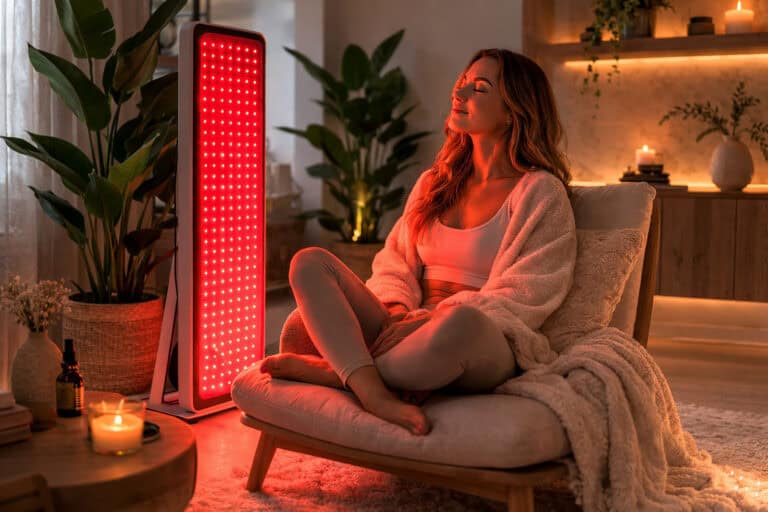
Professional Red Light Therapy Systems Overview

Professional red light therapy systems sit in a different category from small desktop masks, flexible wraps, or entry-level home panels. They are typically larger, more powerful, more configurable, and designed for repeated use in clinics, wellness studios, recovery spaces, and high-commitment home routines. This overview explains what professional red light therapy systems usually offer, where they fit in the market, and what buyers should understand before moving up from consumer-grade gear.
At Red Light Sage, we use conservative, evidence-aligned language because photobiomodulation is still a dosage-sensitive field. Research commonly discusses mitochondrial signaling, ATP production, nitric oxide pathways, and tissue-level responses, but the quality of outcomes can vary based on wavelength, power density, treatment distance, consistency, and protocol design. Reviews in the literature also note that red and near-infrared light are being studied across skin, recovery, inflammation, and tissue-support contexts, while dosing remains one of the biggest real-world variables. Clinical review of low-level light therapy and mechanism-focused PBM research are helpful starting points.
In this review-style overview, “professional” does not automatically mean medically superior. It usually means bigger treatment area, higher workflow flexibility, sturdier build quality, and more room to fine-tune how a system is used. For readers still deciding whether to start with a premium panel or a simpler setup, our Best Red Light Therapy Devices (2026 Buyer’s Guide) gives a broader market view.
Need the broader device landscape first?
Start with our full comparison guide to see where professional systems sit relative to home-use panels, full-body devices, and budget options: Compare the main device categories →
What usually makes a red light system “professional”
In practical terms, professional red light therapy systems are usually defined by scale and workflow rather than by a single magical spec. The most common differences include larger panel size, modular or multi-panel configurations, stronger cooling and heat management, more robust mounting options, better control interfaces, longer expected duty cycles, and easier room integration. Some are designed for a clinician moving quickly between clients, while others are built for a gym recovery room, med spa, or dedicated home wellness space.
Most buyers step into this category for one of four reasons:
- Coverage: they want to treat more of the body at once instead of rotating around a small panel.
- Convenience: they want shorter, more repeatable sessions with fewer awkward repositioning steps.
- Workflow: they need a device that can be used multiple times per day without feeling fragile or improvised.
- Presentation: they want a cleaner, more premium in-room setup for clients or a long-term home installation.
That said, professional systems are not automatically better for every person. A large system can be excessive if your goal is limited facial use, a small recovery area, or an occasional routine. In those cases, a strong home panel from our Best Red Light Therapy Panels for Home Use roundup may be the more rational choice.
How professional systems fit into real-world photobiomodulation use

Photobiomodulation research often centers on how red and near-infrared light interact with tissue-level chromophores and downstream signaling pathways. A common framework is that light energy may influence mitochondrial respiration, nitric oxide signaling, oxidative balance, and cellular communication. Reviews published through PubMed and PubMed Central repeatedly highlight that the biological response is shaped by wavelength, dose, intensity, timing, and tissue depth rather than by marketing language alone. See this broad PBM review and this mechanism overview on anti-inflammatory effects.
Professional systems matter here because they can make dose delivery more consistent across larger treatment areas. That does not eliminate the challenge of good protocol design, but it can reduce one common home-use problem: under-treating a target area because the device is too small, too weak at working distance, or too inconvenient to use consistently.
In other words, professional red light therapy systems are often less about “more science” and more about “less friction.” When a system allows better coverage, easier positioning, and more stable routines, consistency improves. And with light-based wellness devices, consistency often matters as much as raw hardware claims.
The core features that matter most in professional red light therapy systems
When comparing professional red light therapy systems, focus on decision-grade features rather than generic “clinical strength” wording. These are the areas that usually matter most:
1. Treatment area
Larger systems reduce the need to rotate the body through multiple positions. This is one of the biggest quality-of-life upgrades over smaller consumer devices.
2. Wavelength mix
Many systems combine red and near-infrared ranges because superficial and deeper tissues interact differently with light. Research commonly discusses red wavelengths for more surface-level applications and near-infrared for deeper penetration characteristics, though exact protocol fit depends on the goal and the device design.
3. Mounting and positioning
Door mounts, rolling stands, horizontal frames, and modular wall systems can completely change usability. A good system is one you can position easily and repeatably.
4. Cooling and duty cycle
Professional hardware should feel stable during repeated sessions. Better thermal design often supports longevity and reduces performance drift during longer operating periods.
5. Controls and programmability
Preset timers, intensity controls, channel controls, and memory settings become more valuable when more than one person uses the system or when a business wants more standardized client routines.
6. Build quality and support
On expensive equipment, warranty quality, replacement logistics, and responsive support matter as much as the spec sheet.
Typical use cases for professional-grade setups

Professional red light therapy systems usually make the most sense in environments where routine, throughput, or full-body exposure matters:
- Dedicated home wellness rooms: for users who want a permanent setup instead of bringing out a small panel each session.
- Performance and recovery rooms: for athletes or trainers who value larger treatment coverage after intense exercise.
- Med spas and esthetic spaces: where a more polished setup supports skin-focused routines and client flow.
- Chiropractic, rehab, or integrative settings: where light therapy may be used as a supportive modality within a broader service model.
Cleveland Clinic notes that LED-based light therapy and red light therapy are generally noninvasive and appear to have a favorable short-term safety profile when used as directed, but they are not catch-all solutions and should not be framed as cures. See Cleveland Clinic’s red light therapy overview and its separate LED light therapy explainer.
That balanced framing is especially important in the professional category. A bigger system can improve logistics and exposure area, but it does not justify exaggerated health claims.
Where professional systems can outperform smaller home devices
The strongest case for professional red light therapy systems is not usually peak intensity on paper. It is the total package of coverage, ergonomics, and repeatability.
- Better full-body practicality: one session can cover more surface area with fewer position changes.
- Less routine fatigue: users are more likely to stick with a setup that feels convenient and predictable.
- Cleaner room integration: mounted or wheeled systems can feel less cluttered than multiple smaller units.
- Potentially better protocol consistency: the same distance, angle, and timer settings are easier to reproduce.
- Higher perceived professionalism: important for clinics and studios that want a polished client experience.
For some buyers, this category is mainly about reducing operational friction. If you have ever thought, “I know I should use my light panel more often, but setting it up is annoying,” that is exactly the kind of problem a professional system tries to solve.
The real tradeoffs: cost, space, complexity, and diminishing returns

There are also meaningful tradeoffs. Professional red light therapy systems are larger, heavier, more expensive, and often less forgiving when your room layout is not ideal. They can require dedicated wall space, more careful stand selection, or enough clearance to step in and out comfortably. For a home buyer, this can turn a simple wellness device purchase into a mini room-planning project.
There is also the question of diminishing returns. If your main use case is face-focused skin support, a giant system may not materially improve your experience compared with a smaller, high-quality device. Likewise, if you travel often or need flexibility, an oversized system can become something you admire more than you actually use.
Another limitation is evidence interpretation. Research supports growing interest in photobiomodulation, but optimal dosing remains a moving target across applications. That means expensive hardware does not eliminate the need for sensible protocols. A larger system can still be used poorly. This is one reason our How to Use Red Light Therapy Safely page and our session duration and frequency guide remain just as important as the hardware discussion.
What to check before buying a professional system
Before purchasing, work through a practical checklist:
- Room dimensions: Do you have enough depth, side clearance, and ceiling height for safe and comfortable positioning?
- Electrical requirements: Is standard household power sufficient, or will the unit push the limits of your setup?
- Treatment style: Will you stand, sit, lie down, or rotate around it?
- User count: Is this for one person, a family wellness room, or recurring client use?
- Cleaning and maintenance: Can the finish, handles, and controls be maintained easily in a multi-user environment?
- Support and warranty: What happens if a driver, fan, or mounting component fails?
It also helps to compare professional systems against adjacent categories before committing. Some buyers discover that a premium full-body consumer system is enough. Others realize they want a more focused skin-oriented device instead. That is why our Best Full-Body Red Light Therapy Devices roundup and Best Red Light Therapy Devices for Skin & Anti-Aging roundup are useful comparison stops.
Still comparing categories?
See how pro-style systems stack up against other high-coverage options in our full-body device roundup →
How these systems are often used for skin, recovery, and general wellness support

Many buyers look at professional red light therapy systems through one of three lenses: skin-focused routines, exercise recovery support, or general wellness consistency.
Skin-oriented routines
Skin-related interest remains one of the biggest gateways into red light therapy. Published reviews and controlled trials have discussed improvements in aspects of skin appearance and collagen-related parameters under certain PBM conditions, though results depend heavily on protocol quality and patience. Helpful references include a 2023 review on skin aging signs, a controlled trial on skin complexion and collagen density, and a 2023 systematic review of LED use in skin therapy.
Recovery-oriented routines
Recovery-minded users often want bigger panels because they treat larger muscle groups and do not want to reposition repeatedly after training. While the science is still protocol-dependent, PBM continues to be studied for tissue support, inflammation modulation, and recovery-related outcomes.
General wellness routines
Some people simply want a stable, low-friction habit that fits into a morning, post-workout, or evening routine. In that scenario, the value of a professional system may come less from headline specs and more from the fact that it is easy to walk up to and use.
Safety, sensible expectations, and who should be more cautious
Professional red light therapy systems should still be treated as serious light-emitting equipment, not decorative wellness furniture. Eye comfort, exposure distance, session length, heat buildup, and manufacturer instructions all matter. Bigger systems can make it easier to overdo session time simply because they feel impressive.
Users should be especially thoughtful if they are pregnant, highly photosensitive, taking medications associated with light sensitivity, managing an eye condition, or dealing with an active medical situation that deserves clinician input first. Our more detailed guidance lives in Red Light Therapy Safety for Specific Populations and Red Light Therapy Side Effects.
A strong expectation-setting rule is this: professional equipment may improve coverage, convenience, and consistency, but it does not justify guaranteed outcomes. The field is promising, but it is still dose-sensitive and application-specific. Bigger hardware is not the same thing as universally better results.
Who professional red light therapy systems are best for

This category tends to fit best for:
- High-consistency home users who already know they will use red light therapy several times per week.
- Households with multiple users where convenience and fast setup matter.
- Studios, clinics, and recovery spaces that need better ergonomics and a more polished presentation.
- Buyers prioritizing coverage over portability and willing to dedicate space to the setup.
It may be a poor fit for occasional users, small apartments, travelers, or shoppers who have not yet established a consistent routine with smaller equipment. In those cases, starting with a simpler home panel can be the smarter move. Our Best Budget Red Light Therapy Devices roundup is often a better starting point for learning what you actually value in a device.
Bottom-line review of the category
Professional red light therapy systems make the strongest case when the buyer wants scale, consistency, and a dedicated workflow. Their biggest advantages are usually practical: better body coverage, smoother room integration, sturdier build, and easier repeatability. For the right person or facility, those benefits are meaningful and can justify the jump from a consumer device.
But the category also invites overspending. If your room cannot support the system, if your routine is still uncertain, or if your main goal is highly localized use, a professional setup may create more friction than value. The smartest buyers usually compare their available space, desired treatment area, weekly usage pattern, and tolerance for setup complexity before shopping the top end of the market.
That is the lens we recommend: buy for repeatability, not for hype. Choose the system class that you will actually use well.
Final thoughts on professional red light therapy systems

Professional red light therapy systems can be an excellent fit for committed users and serious wellness spaces, especially when full-body coverage, room integration, and repeatable routines matter more than portability or entry-level pricing. Their value is usually highest when they remove friction and make a regular protocol easier to sustain.
If you are still deciding between categories, start broad, then narrow down. Review the Buyer’s Guide, compare larger options in our full-body roundup, browse more education in the Red Light Therapy Blog, or reach out through our contact page if you want help thinking through space, use case, and category fit.