How Red Light Therapy Works at the Cellular Level

Understanding how red light therapy works at the cellular level can make the topic feel much less mysterious. Rather than being “magic light,” red light therapy is usually discussed in terms of photobiomodulation—the way specific wavelengths of light interact with tissues and may influence cellular activity. Researchers are especially interested in how this process relates to mitochondria, ATP production, nitric oxide signaling, circulation, and cell communication.
That does not mean every claim you may see online is automatically proven. The best way to think about red light therapy is as a wellness tool being studied for how it may support normal biological processes when used consistently and appropriately. It is not a cure-all, and results can vary depending on wavelength, dose, distance, tissue depth, and the goal of the session.
In this guide, we’ll break down the basic science in plain English, show what happens when red and near-infrared light reach tissue, and explain why many people pair this topic with our science-backed overview of red light therapy benefits, our practical guide on how to use red light therapy safely, our full Red Light Therapy Blog, and our device comparison resource, Best Red Light Therapy Devices (2026 Buyer’s Guide).
Want the practical next step?
Once you understand the science, compare features, panel sizes, and setup options in our red light therapy device buyer’s guide →
What photobiomodulation actually means
Photobiomodulation is the technical term often used to describe red light therapy. In simple terms, it refers to the use of specific wavelengths of visible red and near-infrared light to interact with cells in a way that may influence biological activity. Instead of heating tissue the way a sauna or heating pad does, the goal is generally to deliver light energy that can be absorbed by light-sensitive components inside the body. The Cleveland Clinic describes red light therapy as a treatment that uses low levels of red or near-infrared light and notes it is being studied for skin and other health applications, while emphasizing the need for realistic expectations and proper use Cleveland Clinic’s red light therapy overview.
The phrase sounds complex, but the core idea is straightforward:
- Light reaches the skin and underlying tissue
- Some of that light is absorbed by cellular structures
- The absorbed light may influence signaling and energy-related processes
- Those changes may support normal cellular function over time
This is one reason wavelength matters. Not every type of light behaves the same way in tissue. If you want a deeper primer on the basics before continuing, see What Is Red Light Therapy? and Red Light Therapy Wavelengths Explained.
What happens when red light reaches tissue
When red light therapy is used correctly, photons from the device reach the skin and may penetrate to varying depths depending on the wavelength, the device power, the distance from the body, and the tissue involved. Red wavelengths are often discussed for more superficial applications, while near-infrared wavelengths are commonly described as reaching somewhat deeper tissues. NIH’s National Center for Complementary and Integrative Health notes that low-level light therapies are being studied for several purposes, but evidence quality varies by application and condition NCCIH on low-level light therapy.
Once light enters tissue, not all of it is used equally. Some is reflected, some is scattered, and some may be absorbed by molecules sometimes called chromophores. These are the light-sensitive targets that can respond when exposed to the right wavelengths. In red light therapy discussions, one of the most commonly referenced targets is cytochrome c oxidase, an enzyme associated with mitochondrial respiration.

This absorption step is the reason red light therapy is so often tied to energy metabolism rather than just surface illumination. The body is not merely being exposed to colored light; the theory is that properly dosed light may influence how cells manage energy and signaling.
Mitochondria, ATP, and why they matter
Mitochondria are often described as the “power plants” of the cell because they help produce ATP, the molecule cells use for energy. That phrase is simplified, but it is helpful. If cells are constantly doing work—repair, signaling, transport, maintenance, and communication—they need a steady supply of energy.
One reason people ask how red light therapy works at the cellular level is because of the proposed relationship between light absorption and mitochondrial activity. Research literature frequently discusses how photobiomodulation may influence mitochondrial respiration and ATP-related processes, though the effect depends heavily on dose and context. PubMed-indexed reviews have described the role of mitochondria and cytochrome c oxidase in these mechanisms PubMed review on photobiomodulation mechanisms.
In practical terms, the theory looks like this:
- Specific wavelengths reach tissue
- Light is absorbed by cellular targets associated with mitochondria
- This may support more efficient energy-related activity
- Cells may then be better positioned to perform routine maintenance and signaling functions
That doesn’t mean “more light is always better.” In fact, photobiomodulation research often points to a dose-response curve where too little light may do very little and too much may be less helpful than expected. This is one reason device quality, treatment distance, and session timing matter so much in home use.
The cytochrome c oxidase theory and nitric oxide signaling
A widely discussed explanation for red light therapy involves cytochrome c oxidase, a component of the mitochondrial electron transport chain. Researchers have proposed that light may influence this enzyme’s activity and may also affect how nitric oxide interacts in the local cellular environment. Mayo Clinic notes that red light therapy is being investigated for tissue repair and inflammation-related applications, but outcomes depend on proper treatment parameters and research is still evolving Mayo Clinic on red light therapy.
Nitric oxide matters because it plays a role in signaling and circulation. In simple terms, some researchers believe that when red or near-infrared light is absorbed, it may help shift local cellular conditions in a way that supports normal nitric oxide dynamics. That may be one reason red light therapy is often discussed alongside circulation and heart health and broader tissue recovery topics.

The key point is that red light therapy is not usually framed as “forcing” the body to do something unnatural. Instead, it is typically described as a way to support normal biological signaling under the right conditions.
How circulation and tissue oxygen use fit into the picture
Once you understand the mitochondrial angle, the next question is often: why do people also talk about circulation? The answer is that energy production, signaling, and tissue oxygenation are closely related. If a tissue area has better local circulation and healthy cellular signaling, that may support the normal delivery and use of oxygen and nutrients.
Photobiomodulation literature often explores these relationships together rather than as isolated events. That is why discussions of red light therapy commonly include:
- microcirculation
- oxygen utilization
- cell-to-cell signaling
- recovery-related pathways
This does not mean every user will “feel” circulation changes immediately. Some people notice only subtle shifts, while others are more aware of local warmth or a post-session sense of relaxation. Practical expectations matter. Many wellness tools work less like a dramatic switch and more like a routine that may support the body gradually when used consistently.

Why cell signaling matters for recovery and normal repair
Cells are constantly communicating. They send chemical signals, respond to stress, adapt to environmental input, and coordinate repair and maintenance. One reason red light therapy has attracted so much attention is that researchers are studying whether photobiomodulation may influence these signaling processes in ways that support normal recovery.
That helps explain why red light therapy shows up in conversations around:
- muscle recovery
- inflammation and immune support
- skin health and anti-aging
- sleep and circadian rhythm
Each of those outcomes involves different tissues and different research questions, but the underlying theme is similar: if cells can manage energy efficiently and communicate well, they may be better able to support normal function. This is still a conservative interpretation, but it is a useful one.
Why the dose matters just as much as the light itself
One of the biggest mistakes in this space is assuming the cellular mechanism alone guarantees results. It doesn’t. Dose matters. That includes the wavelength, output, session length, treatment distance, body area, and how often the device is used.
Researchers often describe a “biphasic dose response,” meaning there may be a beneficial range, while underdosing or overdoing it may be less useful. This is why red light therapy should be approached more like a structured wellness routine than a random exposure.
For home users, that usually means:
- following manufacturer instructions carefully
- using the correct distance from the panel
- not assuming longer sessions always improve results
- giving the process time to work through consistent use

For a practical next step, our guides on how to use red light therapy at home and session duration and frequency help translate the science into everyday use.
Need help choosing a device size or setup?
Red light vs near-infrared at the cellular level
People often use “red light therapy” as a catch-all term, but many devices combine visible red light and near-infrared light. Both are discussed in photobiomodulation research, but they are not identical.
- Visible red light is often associated with more superficial tissues, including skin-focused applications.
- Near-infrared light is commonly described as reaching somewhat deeper tissues, making it relevant in discussions about muscles, joints, and broader tissue support.
That difference in depth is one reason many full-body panels use a mix of wavelengths. Still, the mechanism conversation remains similar: absorption, signaling, mitochondrial support, and dose-dependent response. The specific tissue target is what changes most.

If you want a dedicated explanation of wavelength strategy, visit Red Light Therapy Wavelengths Explained.
What the research supports—and what it does not
It is fair to say there is legitimate scientific interest in photobiomodulation. It is also fair to say the internet often overstates what has been proven. That is why a conservative reading of the evidence is important.
Current research supports taking red light therapy seriously as a topic of study, especially for cellular energy, tissue signaling, skin-related applications, and aspects of recovery. At the same time, not every use case has the same quality of evidence, and not every commercial claim reflects the underlying research accurately. PubMed Central has published broad reviews of photobiomodulation that discuss the promise of these mechanisms while also showing how much depends on treatment parameters and study design PubMed Central review of photobiomodulation.
A practical rule of thumb is this:
- Respect the science
- Ignore miracle language
- Look for evidence-aligned explanations
- Use realistic expectations and safe protocols
That mindset helps you evaluate devices, routines, and claims more clearly as the research continues to evolve.
What this means for real-world home use
If you are using a panel at home, the cellular-level science matters because it shapes expectations. Red light therapy is usually best viewed as a consistency-based wellness practice, not a one-session solution. People commonly build it into routines such as:
- morning sessions for a structured start to the day
- post-workout sessions as part of recovery habits
- evening wind-down routines with careful attention to timing and comfort
- skin-focused sessions with shorter, more targeted exposure
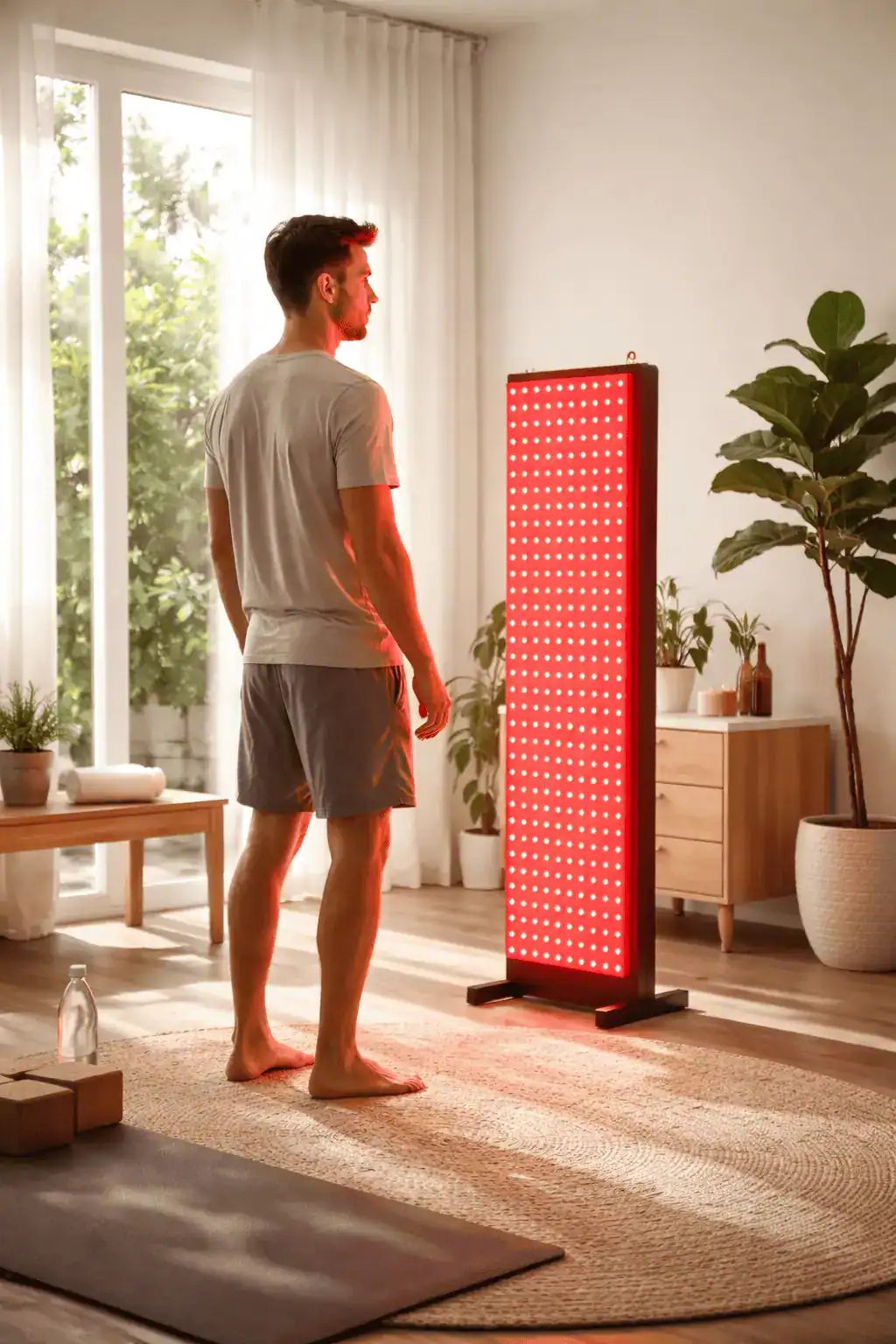
The key is that cellular mechanisms are not separate from everyday use—they are the reason everyday use should be thoughtful. Device placement, distance, session length, and consistency all affect the real-world experience. If you are still comparing form factors, panel sizes, and use cases, browse our blog hub or start with our contact page if you want to understand how we evaluate these devices editorially.
Common misunderstandings about cellular mechanisms
There are a few myths that can make this topic confusing:
Myth 1: If cells absorb light, every device will work the same way
Not true. Wavelength range, irradiance, beam angle, treatment area, and build quality all influence the experience.
Myth 2: Longer sessions always produce better results
Also not true. Photobiomodulation is dose-sensitive, so more is not always better.
Myth 3: Cellular support automatically means medical treatment
No. Supporting normal cellular processes is not the same as diagnosing, preventing, or curing disease.
Myth 4: The science is fake because the mechanism sounds simple
Actually, the opposite is closer to reality. The mechanism is simple to describe at a high level, but the details of wavelength selection, dosing, and tissue response are quite nuanced.
For a broader myth-busting guide, see Red Light Therapy Myths & Misconceptions and our practical overview of red light therapy side effects.
Bottom line
How red light therapy works at the cellular level comes down to a few interconnected ideas: light absorption, mitochondrial activity, ATP-related energy processes, nitric oxide signaling, circulation, and cell communication. The science is promising enough to take seriously, but it should still be approached with caution, proper dosing, and realistic expectations.
If you keep the big picture in mind, red light therapy makes more sense: it is a tool that may support normal biological function when the wavelength, dose, and routine are appropriate. It is not a shortcut, not a guarantee, and not a substitute for medical care. But for people exploring evidence-aligned wellness practices, the cellular mechanism is exactly why this category continues to grow.
Ready to go deeper? Start with our science hub on red light therapy benefits, review safe use guidance on how to use red light therapy safely, browse more articles in the blog, or compare home setups in the 2026 buyer’s guide.