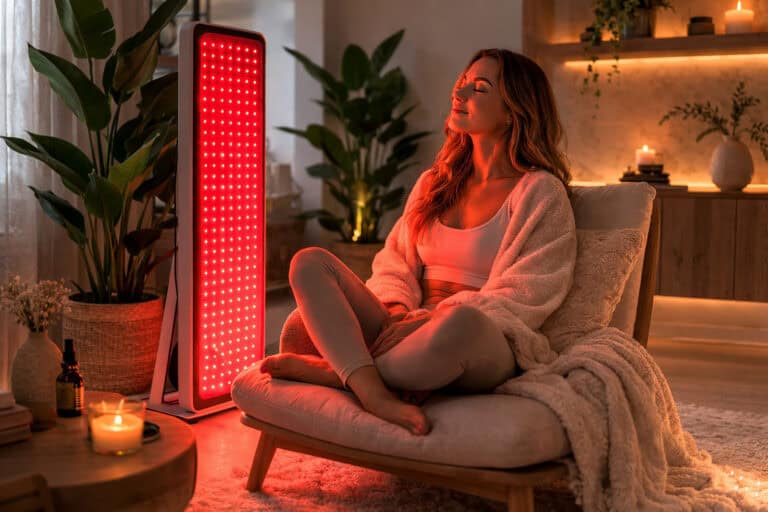
Red Light Therapy for Longevity & Cellular Renewal

Red light therapy for longevity is usually discussed in broad, attention-grabbing terms, but the more useful question is narrower: what does photobiomodulation actually appear to support at the cellular level, and how does that relate to healthier aging? Current research suggests that red and near-infrared light may influence mitochondrial activity, cellular signaling, circulation, and tissue-repair processes, but the evidence is still uneven across outcomes and protocols. That means red light therapy is best understood as a wellness-support tool being studied for cellular resilience and recovery, not as a shortcut to “anti-aging” claims or guaranteed life extension.
In practical home use, the longevity conversation usually overlaps with energy, skin quality, recovery, sleep rhythm, and overall consistency. Those are the areas where people tend to notice whether a routine fits their life. If you are still comparing device categories, start with our Red Light Therapy Buyer’s Guide for a broader overview of home setups and tradeoffs.
Start with the fundamentals first
If you want to compare device types before building a long-term routine, review our best red light therapy devices guide →
What “longevity” really means in a red light therapy context
On a wellness site, longevity should be framed carefully. Red light therapy is not a proven method for extending lifespan in humans. A more evidence-aligned way to discuss it is through cellular renewal, recovery capacity, metabolic resilience, and function over time. Researchers studying photobiomodulation often focus on how light may affect mitochondria, oxidative stress, inflammation signaling, blood flow, and tissue repair rather than on lifespan itself.
That distinction matters because healthy aging is usually about preserving function: maintaining skin integrity, supporting exercise recovery, keeping routines sustainable, and reducing friction around self-care habits. In that sense, red light therapy may fit into a broader healthy-aging strategy alongside sleep, movement, nutrition, and stress management rather than replacing them.

If your main interest is the broad evidence base rather than the longevity angle specifically, see Red Light Therapy Research: What the Evidence Shows for a more general evidence-focused overview.
How red light therapy may support cellular renewal
The most common mechanistic explanation is that photobiomodulation interacts with cellular chromophores and may influence mitochondrial function, especially processes tied to energy production and signaling. Reviews commonly describe effects involving cytochrome c oxidase activity, ATP production, redox balance, and downstream signaling pathways related to repair and adaptation. These mechanistic pathways are the main reason red light is often discussed in the context of cellular renewal rather than just surface-level cosmetics.

Recent reviews also note an ongoing problem: the field still has major variability in wavelength, dose, device type, treatment schedule, and target tissue. That makes it difficult to turn “possible cellular support” into a single universal protocol. In other words, the biology is promising, but standardization is still catching up. For a deeper mechanisms breakdown, read How Red Light Therapy Works at the Cellular Level.
Authoritative reviews discussing these mechanisms include a broad dermatology review of photobiomodulation, which summarizes intracellular signaling and clinical applications, and a recent umbrella review that notes mitochondrial effects as a core theoretical basis while also emphasizing the uneven certainty of evidence across outcomes. PubMed Central review · umbrella review of randomized evidence
Mitochondria, ATP, and why energy support matters for aging
Mitochondria are central to the longevity conversation because aging is often associated with changes in mitochondrial efficiency, oxidative balance, and recovery capacity. Photobiomodulation is frequently studied through this lens. Some research suggests red or near-infrared light may help modulate mitochondrial activity and improve markers tied to cellular energy production. That does not mean more light always equals more benefit, but it helps explain why red light therapy is often discussed for energy, resilience, and recovery.

For healthy aging, this matters because tissues that are repeatedly stressed by exercise, poor sleep, long workdays, or simple wear-and-tear may benefit from routines that support recovery and consistency. The promise is not immortality. It is better framed as support for cellular maintenance and the conditions that help tissues function well over time.
If you want a focused article on this topic, see Red Light Therapy and Mitochondrial Function.
Where people most often connect red light therapy with healthy aging
Most people do not measure “longevity” directly in daily life. They notice more practical signals. That is why red light therapy is usually tied to aging-related wellness goals such as:
- Skin appearance support, including texture and the look of fine lines
- Recovery support after exercise or physically demanding days
- Sleep-routine support when used as part of a calming evening rhythm
- Energy and consistency when sessions are realistic enough to maintain

Cleveland Clinic notes that red light therapy is being studied for skin-related uses such as wrinkles, scars, redness, and acne, while also stressing that more quality trials are still needed for many promoted uses. Stanford Medicine similarly points out that some uses, such as hair regeneration and wrinkle reduction, have more support than many of the more sweeping wellness claims seen online. Cleveland Clinic overview · Stanford Medicine perspective
What the research suggests about brain aging and cognitive longevity
The strongest “longevity-adjacent” angle in newer research may be brain aging rather than generalized anti-aging claims. A 2024 systematic review on photobiomodulation in the aging brain found promising but still heterogeneous evidence across animal and human studies, including signals around working memory, cognitive inhibition, mitochondrial function, ATP levels, and brain metabolic activity. At the same time, the review also emphasized the need for standardized protocols and more homogeneous human data.

This is important because “longevity” is often really a quality-of-life question. Preserving mental sharpness, maintaining daily function, and supporting healthy routines may matter more in day-to-day life than abstract lifespan discussions. The current evidence does not justify dramatic claims, but it does support continued interest in photobiomodulation as a non-invasive area of study for aging-related cognitive wellness. Systematic review on photobiomodulation in the aging brain
Why protocol quality matters more than hype
One reason red light therapy content becomes confusing is that the same phrase can refer to very different devices and treatment approaches. Wavelength, power, treatment distance, treatment duration, body area, and session frequency all shape the real-world experience. Two people can say they are “doing red light for longevity” while using completely different protocols.
That variability is one reason umbrella reviews keep returning to the same conclusion: the field is promising, but standardization is still limited. In practice, that means a reasonable home routine usually looks like:
- choosing a device designed for the body area you care about most
- using it at a consistent distance and schedule
- tracking how your skin, recovery, and routine adherence respond
- avoiding the assumption that longer sessions automatically work better
For practical scheduling help, see Red Light Therapy Session Duration & Frequency and How to Use Red Light Therapy at Home.
How to think about red light therapy as a long-term home routine
Longevity-oriented routines work best when they are sustainable. A device that fits your room, your schedule, and your tolerance for repetition is usually more useful than a device that looks impressive but rarely gets used. In many homes, the most realistic setup is one that can become part of a morning routine, post-workout reset, or evening wind-down.

Common practical considerations include:
- whether you want spot treatment or broader body coverage
- how easy the device is to position consistently
- whether the routine fits your existing habits
- whether you are using it for skin, recovery, general wellness, or a mix
Compare device styles before committing
Panel size, body coverage, and home setup all shape long-term adherence. Compare options in our red light therapy buyer’s guide →
What red light therapy for longevity does not prove
It is worth being direct here: current human evidence does not prove that red light therapy extends lifespan. It also does not justify sweeping promises about reversing aging, replacing exercise, or correcting every low-energy or skin-related concern. Even the more optimistic reviews typically call for better trials, more consistent protocols, and stronger comparative data.
The 2025 umbrella review of randomized clinical evidence found that some outcomes showed moderate-certainty support, but many others remained low or very low certainty, and no outcomes were backed by high-certainty evidence. That is exactly why red light therapy should be framed as a supportive wellness modality under study, not as a miracle category. See the umbrella review
If you are trying to decide whether the category is even a fit for you, read Is Red Light Therapy Right for You?.
Safety and realistic expectations for healthy-aging goals
For most people, the better mindset is to treat red light therapy like a supportive habit rather than a dramatic intervention. Cleveland Clinic notes that red light therapy appears safe in the short term when used as directed, but also points out that long-term safety data for consumer devices is still limited and that misuse can create problems, especially around the eyes. That is another reason consistency and restraint are better than excess.
Realistic expectations often look like this:
- Skin: gradual changes, not overnight transformation
- Recovery: support for a broader recovery plan, not immunity from overtraining
- Energy: a possible supportive effect, not a replacement for sleep or nutrition
- Healthy aging: one tool among many, not a stand-alone longevity strategy
For a safety-first overview, visit How to Use Red Light Therapy Safely.
Who may be most interested in this angle of red light therapy
The longevity framing tends to resonate most with people who are not chasing one isolated outcome. Instead, they are looking for a routine that may support multiple aging-related priorities at once, such as skin wellness, recovery, energy management, and a sustainable self-care rhythm. In observed home-use scenarios, that often includes:
- adults building a long-term wellness routine around work, exercise, and sleep
- people interested in non-invasive support for skin appearance and recovery
- users who want a repeatable home setup rather than periodic spa-style sessions
- buyers comparing panel formats with different coverage and convenience tradeoffs
If that sounds like you, browsing the wider educational hub can help you decide where to go next: Red Light Therapy Benefits, the Red Light Sage blog, and our contact page if you want to suggest a device or topic for future review.
Frequently asked questions about red light therapy for longevity
Does red light therapy increase lifespan?
No human evidence currently shows that red light therapy increases lifespan directly. The more accurate discussion is about whether photobiomodulation may support processes related to healthier aging, such as mitochondrial function, tissue repair, skin wellness, and recovery.
Is cellular renewal the same as anti-aging?
Not exactly. Cellular renewal is a narrower, more defensible concept. It refers to repair, turnover, and maintenance processes in tissues. “Anti-aging” is a broader marketing phrase that often promises more than the evidence supports.
What is the most evidence-aligned reason to try red light therapy if I care about aging well?
For many people, the most grounded reasons are skin-related support, recovery, and a consistent wellness routine that may complement sleep, movement, and stress management. The evidence is stronger for some applications than for broad longevity claims.
Bottom line: red light therapy may support healthier aging, but it is not a longevity shortcut
Red light therapy for longevity is best approached with disciplined expectations. The strongest rationale is not that it “stops aging,” but that photobiomodulation may support some of the cellular and functional processes that matter as we age, including mitochondrial activity, signaling, recovery, circulation, and skin-related wellness. The research is promising in several areas, yet still too variable to justify sweeping claims.
If you want the most practical next step, compare real-world home device categories in our Buyer’s Guide, revisit the science framing on our Benefits page, browse the full blog, or contact us with a question about device fit or home setup.