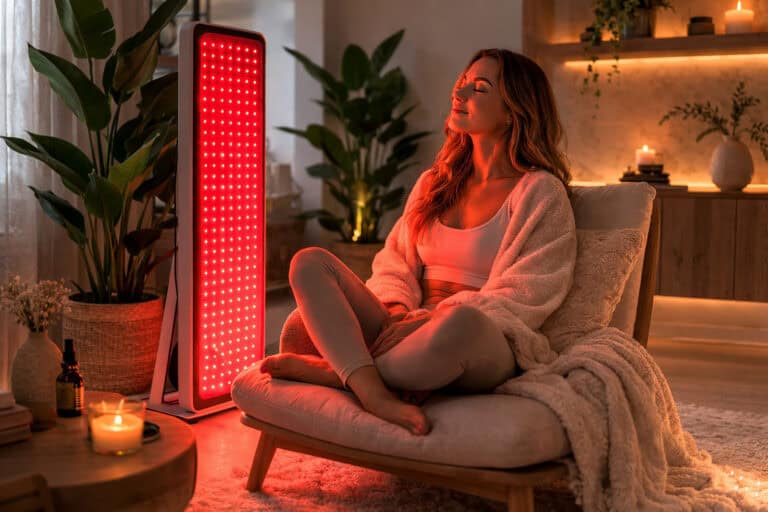
Red Light Therapy for Eye Health

Red light therapy for eye health is a topic that gets a lot of attention, but it needs to be handled with extra care. The basic idea is that certain wavelengths of visible red or near-infrared light may support cellular energy production and photobiomodulation pathways that researchers are studying in relation to retinal function and visual performance. That said, the eye is not just another body area. It is a highly specialized organ, and home experimentation without a conservative framework is not a good idea.
At Red Light Sage, we take a cautious view. Some early clinical and preclinical research has explored whether carefully controlled light exposure may support aspects of retinal metabolism, mitochondrial function, or age-related visual performance. But this area is still developing, and it does not justify broad claims that red light therapy can cure vision problems or replace eye care. A practical starting point is to understand the mechanisms, the limits of the evidence, and the safety issues before deciding whether this topic is even relevant to you.
If you are just getting oriented, start with our overview of what red light therapy is, then compare the broader context in our science-backed benefits page. You can also browse the full Red Light Sage blog or contact us here if you want help navigating the evidence.
Want the bigger picture first?
See how eye-related questions fit into the broader device landscape in our Red light therapy buyer’s guide →
Why eye health needs a different level of caution
Red light therapy for eye health cannot be approached the same way as red light use for muscle recovery, skin support, or general wellness routines. The retina, macula, lens, cornea, and optic pathways all respond differently to light exposure than skin or muscle tissue. Dose, wavelength, timing, and device design matter more here, and “more light” is not automatically better.
Researchers have been interested in the eye because retinal cells are metabolically active and mitochondria-rich. Some studies suggest that aging and retinal stress may be associated with declining mitochondrial efficiency, which is one reason photobiomodulation has been investigated as a possible supportive strategy. A widely discussed small human study published in Scientific Reports examined brief morning exposure to deep red light and reported improvement in color contrast sensitivity in older adults under controlled conditions. This result was intriguing, but it was also limited in size and scope, and it does not establish universal benefit across eye conditions.
There is also an important difference between a tightly controlled research setup and a person pointing a consumer device toward the face at home. Eye-specific use should never be reduced to a trend or a generic recovery hack. If someone has glaucoma, macular degeneration, diabetic eye disease, retinal disorders, recent eye surgery, unexplained visual changes, or photosensitivity concerns, that shifts the conversation immediately toward professional guidance rather than DIY use.
How red light may interact with retinal cells
The main mechanism researchers discuss is photobiomodulation. In simplified terms, specific wavelengths of light may interact with cellular chromophores and influence mitochondrial function, especially around ATP production and cell signaling. This is one reason the eye comes up in photobiomodulation research: retinal tissues have high energy demands.
Several reviews and research discussions have explored how light in the red to near-infrared range may affect mitochondrial respiration, oxidative stress signaling, and cell resilience under certain experimental conditions. For a broader mechanistic overview, PubMed and NIH-linked literature on photobiomodulation discusses pathways involving cytochrome c oxidase, nitric oxide signaling, and downstream changes in cellular metabolism, although exact mechanisms remain under investigation and are not fully settled across every tissue type. A useful scientific overview is available through this PubMed Central review on photobiomodulation mechanisms.

For the eye specifically, the working theory is not that red light “heals vision” in a broad sense. It is that carefully controlled light exposure may support cellular energy balance in some retinal contexts. That is a much narrower and more defensible claim. It also helps explain why timing, wavelength, and total dose matter so much in the research. Eye-related photobiomodulation is not something to generalize from body-panel marketing alone.
If you want a more foundational explanation of how these pathways are discussed across tissues, read our post on how red light therapy works at the cellular level.
What the evidence currently suggests about red light therapy for eye health
The evidence on red light therapy for eye health is promising in places, but still limited overall. A few small human studies and pilot investigations suggest that brief exposure to deep red light may support certain measures of visual performance, particularly in older adults and under tightly controlled study conditions. Some of the interest has centered on color contrast sensitivity, retinal aging, and mitochondrial function.
One of the most cited human papers is the previously mentioned Scientific Reports study, which found that short morning exposure to 670 nm light improved color contrast sensitivity in older participants. Follow-up discussion around this work has emphasized that timing may matter and that responses may differ by age and retinal state. Even so, this is still a far cry from proving effectiveness for everyday home users with diverse eye histories.
Meanwhile, broader ophthalmic literature on photobiomodulation has explored potential supportive roles in retinal disease research, including age-related macular degeneration and other degenerative conditions. Reviews such as this PubMed-indexed discussion of photobiomodulation in retinal disorders help show why scientists are interested in the field, but they also make clear that research remains condition-specific and far from settled.
The most honest summary is this: early research gives enough signal to justify scientific interest, but not enough certainty to justify broad wellness claims aimed at everyone’s eyes. That distinction matters.
Where the evidence is still weak or incomplete
When people hear that there is “research” on red light therapy for eye health, they often assume the science is stronger than it really is. Here are the most important limitations:
- Many studies are small or preliminary.
- Study protocols vary widely in wavelength, intensity, exposure distance, and timing.
- Some papers look at narrow outcomes such as contrast sensitivity rather than broad visual improvement.
- Results from lab models or disease-specific populations do not automatically apply to healthy individuals.
- Consumer devices are not interchangeable with research devices.

There is also a practical issue: the phrase “eye health” is broad. It can refer to visual comfort, retinal aging, screen-related strain, dry eye symptoms, contrast sensitivity, disease risk, or overall visual function. A study that measures one of those outcomes does not validate claims about all the others. This is why it is better to read eye-related red light therapy claims with the same skepticism you would use for supplement marketing.
For a broader reality check on what studies can and cannot tell us, see our guide to what the evidence actually shows.
Safety considerations matter more here than in most red light topics
If there is one takeaway that deserves emphasis, it is this: do not assume that general red light therapy practices translate safely to the eyes. Device distance, beam intensity, exposure duration, and direct ocular exposure all matter. Even when visible red light is being studied, protocols are usually tightly controlled. Consumer panels can vary substantially in output and may not be intended for eye-directed use.
The American Academy of Ophthalmology and mainstream eye-care guidance do not frame red light therapy as a routine self-directed treatment for eye disease, and that should shape expectations. Anyone with a diagnosed eye condition, recent surgery, active retinal symptoms, medication-related photosensitivity, or unexplained vision changes should speak with an eye professional before considering anything beyond general reading on the topic.
It is also smart to separate “light in the room” from “deliberately exposing the eyes.” Sitting in a room with a device nearby is not the same as aiming a panel toward the eyes or attempting unsupervised retinal exposure protocols. Some research uses very brief doses and specific timing windows. Recreating that with a generic home setup is not straightforward.

If safety is your main question, review how to use red light therapy safely and our post on red light therapy side effects before you consider any eye-related application.
What a conservative home-use mindset looks like
For most people, the safest and most realistic way to think about red light therapy for eye health is not as a direct eye protocol, but as a topic of research relevance that deserves caution. In real home settings, people often use red light devices for skin, recovery, or general wellness while wondering whether incidental or carefully managed exposure has any relevance to the eyes. That is different from chasing a vision improvement protocol.
A conservative home-use mindset includes:
- Not assuming that face-level device use is the same as eye-specific therapy.
- Following manufacturer safety guidance closely.
- Avoiding direct experimentation with long sessions or close distances.
- Recognizing that eye symptoms should be evaluated medically, not self-treated online.
- Keeping expectations narrow and evidence-based.
In other words, someone interested in photobiomodulation and aging should treat the eye-health question as a research-informed caution zone, not a shortcut to self-treatment. That perspective is less exciting, but much more responsible.
Screen fatigue, dryness, and visual strain are not the same thing as retinal support
One reason this topic gets confusing is that people bundle several different experiences together. Eye fatigue after screen time, dry-eye discomfort, visual strain, age-related retinal change, and diagnosed eye disease are all separate issues. Red light therapy research related to retinal mitochondria does not automatically tell us anything about digital eye strain from long hours at a computer.

If your main issue is screen-heavy living, a more grounded approach may involve standard eye-care basics first: regular breaks, better lighting, blink awareness, ergonomic screen placement, and professional evaluation where needed. Red light therapy may still be interesting from a broader wellness standpoint, but it should not distract from low-tech habits that have clearer day-to-day relevance.
This is one reason we encourage readers to keep the whole-person context in view. You may get more value from improving sleep rhythm, general recovery, and home routine consistency than from trying to force an eye-health protocol out of incomplete research. Our article on red light therapy for sleep and circadian rhythm is useful if your visual fatigue is tied to late-night habits and recovery patterns.
Looking at devices more broadly?
Compare the current landscape in our best red light therapy devices guide →
Who should be especially cautious with red light therapy for eye health
Extra caution is warranted if any of the following apply:
- You have a diagnosed retinal or macular condition.
- You have glaucoma or optic nerve concerns.
- You recently had eye surgery or procedures.
- You experience unexplained flashes, floaters, blurring, or visual distortion.
- You take medications associated with light sensitivity.
- You are trying to manage a condition that should be under ophthalmology care.
In those situations, reading about photobiomodulation is fine, but applying it without professional input is not a good tradeoff. Research settings are controlled for a reason. The eye is too important to treat casual online advice as a substitute for individualized guidance.
If you fall into a more complex category, our article on red light therapy safety for specific populations may help you frame the right questions before you go further.
Questions to ask before considering any eye-related red light use
Before doing anything beyond general reading, it helps to ask:
- Am I looking for general wellness information, or am I trying to address an actual eye symptom?
- Is the evidence I am relying on from controlled ophthalmic research, or from general red light marketing?
- Does my device have guidance that is relevant to facial or ocular exposure?
- Would an eye-care professional want to know about my plans based on my age, symptoms, or history?
- Am I expecting too much from a field that is still emerging?

These questions may sound cautious, but that is exactly the point. Red light therapy for eye health is one of those subjects where restraint is part of good judgment. A careful reader should come away more informed, not more reckless.
Frequently asked questions about red light therapy for eye health
Can red light therapy improve vision?
It may support certain visual measures in some controlled research contexts, but there is not enough evidence to say that red light therapy broadly improves vision for everyone. The strongest claims online usually go beyond what current research supports.
Is red light therapy safe for the eyes?
That depends on wavelength, dose, exposure pattern, device type, and individual eye history. Because the eye is highly sensitive, safety should be taken more seriously here than in general body use. People with eye disease, surgery history, or visual symptoms should get professional guidance first.
Does research on red light therapy for eye health look promising?
Yes, some early research is promising enough to justify ongoing scientific interest, especially around retinal metabolism and aging. But promising is not the same as proven, and the literature is still too limited to support broad consumer claims.
Should I use a regular red light panel directly on my eyes?
A regular body or face panel should not be assumed to be appropriate for direct eye-focused use. Research protocols are controlled and specific. General consumer use is not automatically equivalent, which is why a conservative approach is essential.
Key takeaways on red light therapy for eye health

- Red light therapy for eye health is being studied, especially in relation to retinal energy metabolism and aging.
- Some early human evidence is encouraging, but it is still limited and protocol-specific.
- The eye should not be treated like skin or muscle when thinking about at-home red light use.
- Broad claims about curing vision problems are not supported by the current evidence.
- Anyone with symptoms or diagnosed eye conditions should prioritize professional care over experimentation.
In other words, the right mindset is curiosity paired with restraint. This is a legitimate research topic, but not a shortcut to self-treatment. The best use of the current evidence is to understand what scientists are investigating, where the uncertainty still sits, and why eye-related photobiomodulation should be treated with far more care than generic wellness marketing suggests.
Final thoughts
Red light therapy for eye health sits at the intersection of legitimate scientific curiosity and internet overstatement. There is enough early evidence to say the field is worth watching. There is not enough evidence to treat it as a proven do-it-yourself solution for vision concerns. For most readers, the smartest move is to stay conservative, stay informed, and avoid turning limited research into personal treatment plans.
If you want to keep learning without getting pulled into hype, start with our benefits page, browse the blog index, or review the broader device landscape in our buyer’s guide. If you have a more specific question about how we frame research topics on the site, you can always contact Red Light Sage.
Next step
Want a broader evidence-based perspective before you look at devices? Start with What Is Red Light Therapy? →