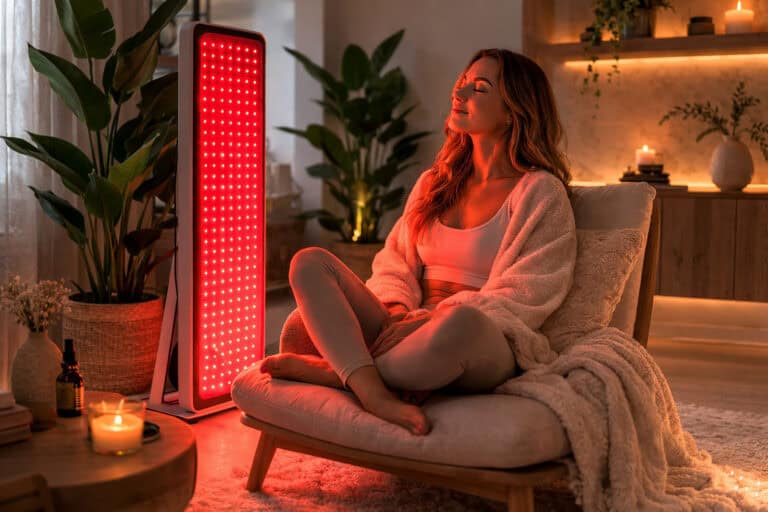
Red Light Therapy Myths & Misconceptions

Red light therapy myths are everywhere. Some make the practice sound like a miracle fix for nearly everything, while others dismiss it as pure hype. The truth sits in the middle. Red light therapy, often discussed under the broader term photobiomodulation, is a real area of research involving red and near-infrared light, but the quality of evidence varies widely depending on the goal, the device, the wavelength, and the treatment protocol.
That makes it easy for confusion to spread. A person may hear that red light therapy “heals anything,” “works instantly,” or “is just a red-colored heat lamp,” and none of those summaries is accurate. Some uses are better studied than others, especially in skin-related applications, while other claims are still early, mixed, or highly device-dependent. Reviews from dermatology and photobiomodulation literature consistently describe the field as promising, but not unlimited, and clinical experts still urge people to be cautious with sweeping claims and low-quality consumer devices.
In this guide, we’ll break down the most common red light therapy myths and misconceptions in plain language. You’ll see where the science is reasonably supportive, where the evidence is still developing, and how to think more clearly about at-home use. For a broader overview of devices and formats, see our Best Red Light Therapy Devices (2026 Buyer’s Guide). You can also explore our foundational pages on red light therapy benefits, the full Red Light Sage blog, or contact us with editorial questions.
Want the practical side too?
After clearing up the myths, compare the major formats and home-use options in our red light therapy buyer’s guide →
Myth #1: Red Light Therapy Is Either a Miracle Cure or Total Nonsense
This is probably the biggest misconception of all. Red light therapy is not magic, but it is also not automatically fake just because some marketers exaggerate it. A more accurate view is that photobiomodulation is a legitimate light-based intervention being studied across skin health, tissue support, inflammation-related pathways, recovery, and other areas. The challenge is that many claims run far ahead of the strongest human evidence.
For example, dermatology sources and clinical reviews often point to more established interest around skin appearance, collagen-related support, and certain inflammatory skin concerns, while broader claims about systemic performance, hormones, or deep medical outcomes typically require more careful interpretation. A 2024 dermatology review of photobiomodulation describes red and near-infrared light as biologically active and relevant in clinical and at-home contexts, but it does not support the idea that one light panel is a cure-all for every condition. Likewise, Cleveland Clinic frames red light therapy as an emerging option that shows promise in some areas while still needing more high-quality trials for many uses. Dermatology review · Cleveland Clinic overview
So the balanced takeaway is simple: red light therapy may support specific wellness and cosmetic goals, but it should not be treated like a universal answer. The smartest mindset is neither blind belief nor automatic dismissal. It is careful matching between claim, device, protocol, and evidence level.
Myth #2: Every Red Light Device Works the Same Way
Not even close. One of the biggest reasons people get confused is that “red light therapy” sounds like a single product category, when in reality it covers many different devices, power outputs, beam angles, treatment sizes, and wavelength mixes. A small mask, a targeted joint wrap, and a full-body panel may all use red or near-infrared light, but they are not interchangeable.
Wavelength matters because different parts of the red-to-near-infrared spectrum interact with tissue differently, and treatment parameters matter because dose can influence whether a session is useful, minimal, or excessive. Reviews in photobiomodulation literature repeatedly emphasize that wavelength, irradiance, timing, and treatment area all shape outcomes. That is one reason broad statements like “red light therapy works” or “red light therapy doesn’t work” are too vague to be helpful. 2024 photobiomodulation overview · Lasers vs LEDs review
In practical home-use terms, device quality differences can affect:
- how much usable light reaches the treatment area,
- whether the device combines red and near-infrared wavelengths,
- how evenly a large body area can be covered,
- how easy it is to use consistently,
- and whether the manufacturer provides meaningful specifications.
If you want to understand those variables in more detail, read Red Light Therapy Wavelengths Explained and our guide to how to use red light therapy at home.

Myth #3: Red Light Therapy Is Just Heat in a Different Package
This is a common mix-up, especially because some people confuse red light therapy with infrared saunas or heat lamps. Proper photobiomodulation is not mainly about heating tissue. Instead, it involves exposing tissue to specific wavelengths of light that may influence cellular signaling, including pathways associated with mitochondrial activity and nitric oxide signaling. That mechanism is very different from simply warming the body.
That does not mean all devices feel identical. Some can produce mild warmth depending on design and treatment distance, but warmth is not the core reason the therapy is being studied. A person can feel almost no heat at all and still be using a real red light therapy device. Conversely, a device that feels hot is not automatically better. The mechanism-focused literature consistently treats photobiomodulation as a light-dose issue rather than a “more heat equals more benefit” issue. Photobiomodulation mechanism overview
That distinction matters because it helps people compare categories more accurately. Red light therapy is not the same as ultraviolet tanning, not the same as a heating pad, and not the same as an infrared sauna session. They can all involve energy exposure, but they operate through different modalities and should not be judged as if they were identical.
Myth #4: Longer Sessions Always Work Better
More is not automatically better. In photobiomodulation, dose matters, and there is a long-standing concept that too little may do very little while too much may not improve results and may be less useful than a more appropriate dose. This is one reason session length recommendations vary so much between devices and use cases. The correct goal is not “maximum minutes.” It is appropriate exposure delivered consistently.
For home users, this misconception often leads to unnecessarily long sessions or unrealistic routines that are hard to sustain. A person might assume that if 10 minutes is good, then 40 minutes must be four times better. That is not how this field is usually interpreted. Device specifications, treatment distance, wavelength mix, and the intended body area all matter. A practical, repeatable protocol is often more valuable than occasional marathon sessions.
This is also where hype creates bad expectations. Some brands market convenience while others market intensity, but neither label tells you whether a protocol is well matched to the goal. If you want the fuller protocol discussion, see Red Light Therapy Session Duration & Frequency.

Myth #5: If You Don’t Notice a Change Right Away, It Doesn’t Work
Another myth is that red light therapy should produce immediate, dramatic changes after one or two sessions. Some people may notice short-term subjective changes, such as feeling relaxed or appreciating the routine itself, but many of the outcomes commonly discussed in research are gradual and depend on repeated exposure over time. That is especially true for appearance-related goals, routine recovery support, and general consistency-based use.
Consumer disappointment often comes from unrealistic timelines. If someone buys a device after hearing strong before-and-after marketing language, they may expect a visible transformation in days. Clinical experts generally describe red light therapy in more measured terms. For example, Mayo Clinic commentary on light-based skin treatments notes that device effectiveness can vary and that over-the-counter tools should not be assumed to deliver the same results as professional care. Mayo Clinic dermatologist commentary
A better expectation is that results, when they occur, may depend on:
- consistent use over weeks rather than days,
- using a device appropriate to the target area,
- maintaining realistic goals,
- and not expecting one device to replace overall sleep, training, skincare, or recovery habits.
That is why routine design matters so much. A therapy that is plausible in theory still has to be practical in real life.
Myth #6: Red Light Therapy Is Basically the Same Thing as Tanning
This myth can scare people away unnecessarily. Red light therapy is not the same as ultraviolet tanning. Ultraviolet light is associated with skin damage and skin cancer risk, which is why dermatologists consistently advise avoiding unnecessary UV exposure. Red light therapy devices used for photobiomodulation operate in a different part of the light spectrum and are studied for different reasons.
That does not mean all red light products are automatically risk-free in all settings, but it does mean the common “it’s just another tanning gimmick” line is misleading. Mayo Clinic dermatology guidance on light therapy clearly distinguishes beneficial therapeutic uses of certain wavelengths from harmful UV exposure. Mayo Clinic light therapy explanation
The more accurate comparison is this:
- UV tanning: associated with skin damage risk and not the goal of photobiomodulation.
- Red or near-infrared photobiomodulation: studied for tissue signaling, skin appearance support, and other non-UV applications.
So while both involve light, they should not be treated as the same category.

Myth #7: Red Light Therapy Can Replace Sleep, Exercise, Nutrition, or Medical Care
Red light therapy is often marketed in language that makes it sound like a shortcut. That is one of the most persistent red light therapy myths. Even where there is supportive evidence, photobiomodulation is usually better viewed as a potential adjunct rather than a replacement for foundational habits or appropriate clinical care.
For example, if a person is interested in sleep quality, recovery, skin appearance, or energy support, the broader context still matters. Sleep timing, exercise load, skincare routine, stress, nutrition, and medical evaluation for persistent symptoms all remain central. Light exposure may support a plan, but it does not make the rest of the plan irrelevant.
This is an especially important point for YMYL-style topics. Red light therapy should not be framed as a substitute for diagnosis, treatment planning, or medical follow-up when symptoms are significant, worsening, or unexplained. It is much safer and more accurate to describe it as one possible tool inside a wider health and wellness approach.
Choosing a home device?
Clear up the myths, then compare practical options in our Best Red Light Therapy Devices guide →
Myth #8: LED Devices Don’t Count as Real Photobiomodulation
Some people assume only laser-based systems are “real” and that LED devices are too weak to matter. That oversimplifies the field. Reviews comparing lasers and LEDs in photobiomodulation note that both can be used in therapeutic contexts, and device performance depends on the broader treatment parameters rather than the simplistic rule that one category is always valid and the other is always useless. Lasers vs LEDs review
In the home market, LEDs are especially common because they are more practical for consumer products and larger treatment surfaces. That does not mean every LED device is worth buying. Some may be underpowered, poorly specified, or designed mainly around aesthetics. But it also does not mean LED-based therapy is automatically fake. The better question is whether the device provides meaningful specifications, appropriate wavelengths, and enough coverage for the intended use.
In other words, “LED” is not a verdict. It is just one part of the device architecture. You still need to look at the whole setup.

Myth #9: A Few Positive Studies Mean All Claims Are Settled
This is one of the most subtle misconceptions. People often hear that “studies show red light therapy works,” but that phrase can hide a lot of complexity. The evidence base includes different populations, devices, wavelengths, endpoints, and study sizes. Some studies are encouraging, some are mixed, and some target highly specific contexts that do not automatically transfer to every consumer device or wellness claim.
That is why evidence summaries are more useful than cherry-picked headlines. A review may conclude that photobiomodulation is promising for a given category while also emphasizing the need for better standardization, better trials, and clearer treatment protocols. That is not a contradiction. It is what a developing evidence base often looks like.
As a reader, a few habits help:
- separate cosmetic claims from medical claims,
- check whether the evidence is based on at-home LEDs, office-based devices, or another format,
- look for review articles rather than one dramatic study,
- and be cautious when marketers use “science-backed” as a substitute for specifics.
If you want the broader evidence discussion, read Red Light Therapy Research: What the Evidence Shows.
Myth #10: If Red Light Therapy Is Generally Safe, Precautions Don’t Matter
It is fair to say that red light therapy is often described as noninvasive and generally well tolerated in many contexts. But “generally safe” does not mean “requires no judgment.” Safety still depends on the device, the body area, the protocol, and the person using it. Eye exposure, sensitivity issues, medication interactions related to light sensitivity, and condition-specific concerns can all matter in certain situations.
Clinical sources commonly recommend following device directions, avoiding sloppy assumptions about exposure time, and speaking with a qualified clinician when a person has an eye condition, a photosensitivity issue, a complicated medical history, or questions about whether an at-home product is appropriate. Cleveland Clinic explicitly notes that more evidence is still needed in many areas and recommends talking with a healthcare provider for condition-specific questions. Cleveland Clinic guidance
That is also why our safety resources exist. For a more complete practical overview, visit How to Use Red Light Therapy Safely and Red Light Therapy Safety for Specific Populations.

Common Questions About Red Light Therapy Myths
Is red light therapy a scam?
No. The better answer is that red light therapy is a real research area with real biological rationale, but the consumer market contains both responsible and exaggerated claims. Some uses are more credible than others, and not every device deserves trust just because it glows red.
Is red light therapy scientifically proven for everything people claim online?
No. Some categories, especially skin-related uses, have more support than many of the sweeping systemic claims seen in social content and ads. Evidence quality varies, and one positive study does not prove every marketing promise.
Do expensive devices always work better?
Not automatically. Better build quality, specs, coverage, and design can matter, but price alone does not guarantee better outcomes. A clear protocol and realistic use case are more important than brand prestige by itself.
Is red light therapy safe to do at home?
For many people, at-home use may be reasonable when the device is reputable and the instructions are followed carefully. But safety still depends on the individual and the use case, especially around eyes, photosensitivity, and special populations.
The Bottom Line on Red Light Therapy Myths & Misconceptions
The most useful way to think about red light therapy is neither as a miracle cure nor as meaningless hype. It is a real photobiomodulation category with plausible mechanisms, growing clinical interest, and a mixed-but-promising evidence base that depends heavily on context. That means the best response to bold claims is not cynicism or blind optimism. It is better questions.
Ask what the goal is. Ask what wavelengths and treatment parameters are being used. Ask whether the claim is cosmetic, wellness-oriented, or drifting into unsupported medical territory. Ask whether the routine is realistic for home use. And ask whether the evidence matches the exact promise being made.
That approach will save you from most red light therapy myths. It will also help you shop, read studies, and set expectations more intelligently.
Next step:
Now that you know what to ignore, compare formats and practical options in our Best Red Light Therapy Devices (2026 Buyer’s Guide) →