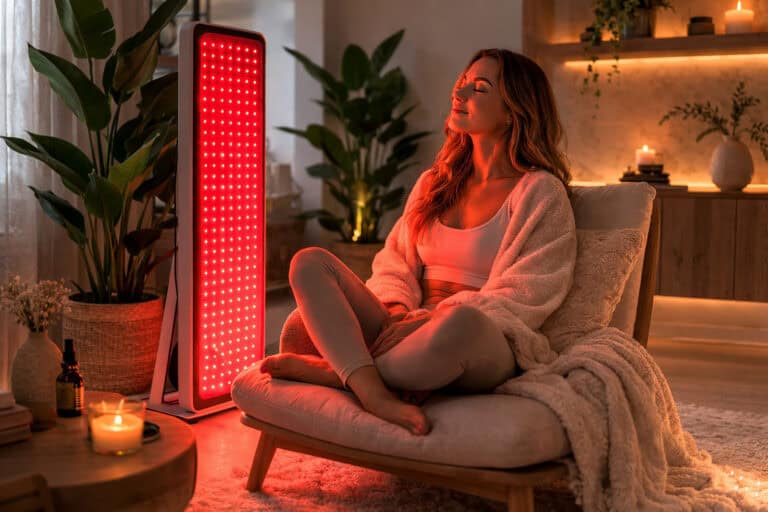
How Red Light Therapy Boosts Energy and Mitochondrial Function.

⚡ Feeling low on energy? One reason might be sluggish mitochondrial function—and that’s exactly where red light therapy (photobiomodulation) shines. In this guide, we’ll unpack how specific wavelengths (typically ~660 nm red and ~850 nm near-infrared) can nudge your cells’ powerhouses to make more ATP, improve recovery, and support overall vitality.
If you’re comparing panels for an at-home setup, start with our 2025 Red Light Device Roundup. For broader wellness gains, see the Benefits page and the Blog Index. Questions? Contact us anytime.
🔬 Photobiomodulation 101: Why Mitochondria Respond to Red/NIR Light
Red and near-infrared (NIR) light interact with cellular chromophores—especially cytochrome c oxidase (Complex IV) in the mitochondrial electron transport chain (ETC). This interaction can:
- 🧪 Displace nitric oxide (NO) bound to Complex IV, improving oxygen binding and electron flow.
- 🔋 Increase mitochondrial membrane potential (ΔΨm), reinforcing the proton gradient that powers ATP synthase.
- 🧯 Modulate reactive oxygen species (ROS) at low, signaling levels, triggering adaptive antioxidant and repair pathways.
The sweet spot for most tissues: red (~630–670 nm) for more superficial targets and NIR (~810–880 nm) for deeper penetration. That’s why many high-quality panels combine 660 nm + 850 nm to cover both ranges.

⚙️ From Photons to Power: How ATP Actually Increases
Here’s the simplified chain of events many studies propose:
- Photon absorption: 660/850 nm light is absorbed by Complex IV.
- ETC throughput rises: Electron transfer improves, boosting proton pumping across the inner mitochondrial membrane.
- Stronger proton gradient: A steeper gradient spins ATP synthase more efficiently.
- More ATP: Cells produce more ATP to fuel muscle work, brain function, and recovery processes.
- Adaptive signaling: Mild ROS and downstream pathways (e.g., NRF2) upregulate antioxidant defenses and mitochondrial biogenesis.
The practical upside: users often report better daytime energy, faster post-workout recovery, and improved stress resilience—outcomes consistent with higher cellular energy availability.

📚 What the Research Suggests
Peer-reviewed studies on photobiomodulation report improvements in ATP production, muscle performance, and fatigue resistance after red/NIR exposure. Mechanistic work shows enhanced Complex IV activity and membrane potential; applied studies in athletes and rehab contexts note modest but meaningful gains in time-to-exhaustion, soreness, and recovery markers when dosed correctly.
Important caveats:
- 📏 Dose matters (fluence & irradiance). Too little may under-stimulate; too much can blunt benefits.
- ⏱️ Timing relative to training or rehab can influence outcomes.
- 🧍 Tissue depth determines whether red or NIR is preferable (or a mix).
Bottom line: the signal is encouraging for energy metabolism and recovery, but outcomes hinge on wavelength, intensity, duration, and distance—all factors we’ll translate into practical protocols next.
🎯 Evidence-Based Dosing for Energy Support
To actually trigger mitochondrial benefits, dosimetry matters. Most research-backed ranges for cellular stimulation sit between:
- Fluence (energy density): 3–10 J/cm² for facial or superficial tissue, 20–60 J/cm² for deeper muscles.
- Irradiance (power): 30–100 mW/cm² at the target surface.
- Exposure time: 5–15 minutes per area, depending on distance and panel output.
- Frequency: 3–5 sessions per week for general vitality, 4–6 for athletes or rehab use.
Staying in this “low-level” zone ensures you stimulate mitochondrial enzymes without tipping into oxidative stress. Going beyond 60 J/cm² can actually reduce ATP production—a classic example of hormesis.
For more wellness-based dosing advice, visit our Red Light Therapy Benefits guide.
⏰ Timing Your Sessions: Pre vs. Post-Workout

Timing affects how your body utilizes the energy boost. Here’s what current research and athlete protocols suggest:
- Pre-workout (1–2 hrs before): Pre-conditioning with red light can prime muscles for oxygen use, reduce fatigue, and improve endurance.
- Post-workout (within 1 hr): Helps counter oxidative stress and speed recovery by supporting ATP replenishment and reducing inflammation.
Try alternating both for two weeks—some users report stronger energy stability throughout the day when sessions occur in the morning or early afternoon.
🏋️♂️ Clinical review: a 2024 PubMed meta-analysis confirmed that near-infrared pre-exercise dosing enhanced peak torque output and reduced muscle soreness in trained subjects.
💪 Who Benefits Most?
Almost everyone can gain from better mitochondrial efficiency, but red light therapy shows especially strong results in:
- 🏃♀️ Athletes — improved recovery, endurance, and reduced delayed-onset soreness.
- 💼 Professionals with fatigue — boosts daytime alertness and resilience to stress.
- 🧠 Individuals with brain fog or burnout — enhanced mitochondrial output supports neuronal energy metabolism.
- 🧓 Aging adults — combats age-related decline in mitochondrial density and ATP production.
The key mechanism across all groups: better electron flow through Complex IV and downstream improvements in cellular oxygen use. More energy per cell means smoother systemic performance.
🔋 Recommended Red Light Panels for Energy & Mitochondria
This section contains affiliate links. We may earn a commission at no cost to you.
Based on power output, safety certification, and wavelength accuracy, here are two trusted options for energy optimization:
- Joovv Solo 3.0 — premium 660 nm / 850 nm spectrum, medical-grade LEDs, modular design.
- Platinum LED BIO Max 900 — balanced irradiance for both superficial and deep tissues, great cost-to-output ratio.
Both units support mitochondria-targeted therapy for energy recovery and metabolic health. Compare detailed specs in our 2025 Buyer’s Guide.
🧬 Cellular Signaling and the Antioxidant Response
Red light therapy doesn’t just fuel mitochondria—it also triggers downstream cellular signaling cascades. As mitochondria produce more ATP and low levels of reactive oxygen species (ROS), cells respond by activating transcription factors such as NRF2 and PGC-1α. These control genes involved in antioxidant defense and new mitochondria formation.
💡 In other words, red light therapy initiates a controlled stress signal—just enough to nudge the body toward adaptation, not damage. Over time, this leads to greater metabolic efficiency and resilience to oxidative stress.
Studies referenced in NIH-funded research indicate consistent upregulation of antioxidant enzymes (SOD, catalase) and higher mitochondrial density after regular sessions lasting four to eight weeks.
🌞 Beyond Energy — Whole-Body Effects
Because mitochondria exist in every cell type, improving their function translates to benefits throughout the body:
- 🧠 Brain and mood: better neuronal energy metabolism and neurotransmitter balance.
- 💪 Muscles: faster recovery and improved oxygen utilization during endurance activity.
- 💖 Cardiovascular system: enhanced nitric-oxide signaling supports vascular flexibility.
- 🦠 Immune cells: better mitochondrial health strengthens innate defense mechanisms.
It’s no wonder red light therapy is being explored for fatigue syndromes, chronic inflammation, and age-related decline. A stronger mitochondrial network often means better overall vitality.
🛡️ Safety and Best Practices
Like all bioactive therapies, dose and discipline matter. Follow these principles for safe, sustainable results:
- ✅ Keep exposure within 3–10 J/cm² for face and 20–60 J/cm² for larger muscles.
- 😎 Wear eye protection if working near face-level panels.
- 📏 Maintain 12–18 inches distance and avoid skin heating.
- 📅 Cycle 4–6 weeks on, 1 week off to avoid desensitization.
Red light therapy remains non-invasive, with minimal adverse reports. If you have underlying medical conditions or use photosensitizing medication, consult your healthcare provider first. For a full overview of safety, read our Safety & Usage Guide.

❓ Frequently Asked Questions
How long before I notice more energy?
Most users report mild improvements in energy and focus within two weeks of consistent use. Full mitochondrial adaptations often take four to six weeks.
Can I combine red light therapy with cold exposure or sauna?
Yes. Alternating thermal and light stressors may synergize mitochondrial resilience—see our guides on cold plunge therapy and infrared saunas.
Do I need both red and near-infrared wavelengths?
Ideally, yes. Red (~660 nm) supports skin-level cells, while NIR (~850 nm) reaches muscles, joints, and deeper tissues.
Is it safe to use every day?
Daily use is safe at moderate doses. If fatigue or sensitivity occurs, take a 1–2-day break to allow recovery.
🌟 The Bottom Line
Red light therapy offers a unique, non-invasive way to enhance mitochondrial energy production—literally lighting up the body’s cellular engines. By improving electron transport, ATP synthesis, and antioxidant capacity, consistent use can translate to higher energy, faster recovery, and better resilience.
Start slow, track your results, and use clinically calibrated devices for best outcomes. Over time, you’ll likely feel the difference in stamina, focus, and vitality—from the inside out.
🔗 Learn more on our Red Light Sage Home Page or check our Blog Index for more science-backed wellness topics.